Back to Home
Folded Cascode Op-Amp
What is it?
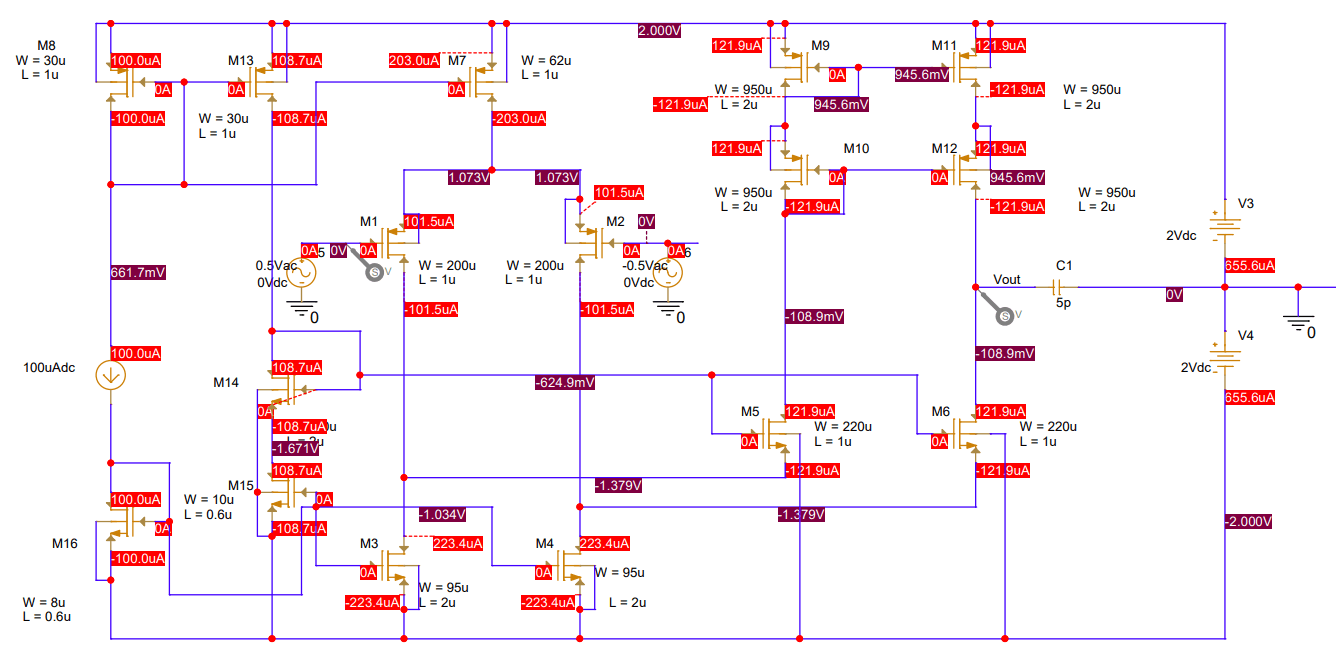
A unity-gain-stable, single-stage folded cascode operational amplifier designed from scratch and simulated in PSpice. Every transistor was sized by hand using gm/Id design charts to hit gain, phase margin, and slew rate targets at low bias current.
Objectives
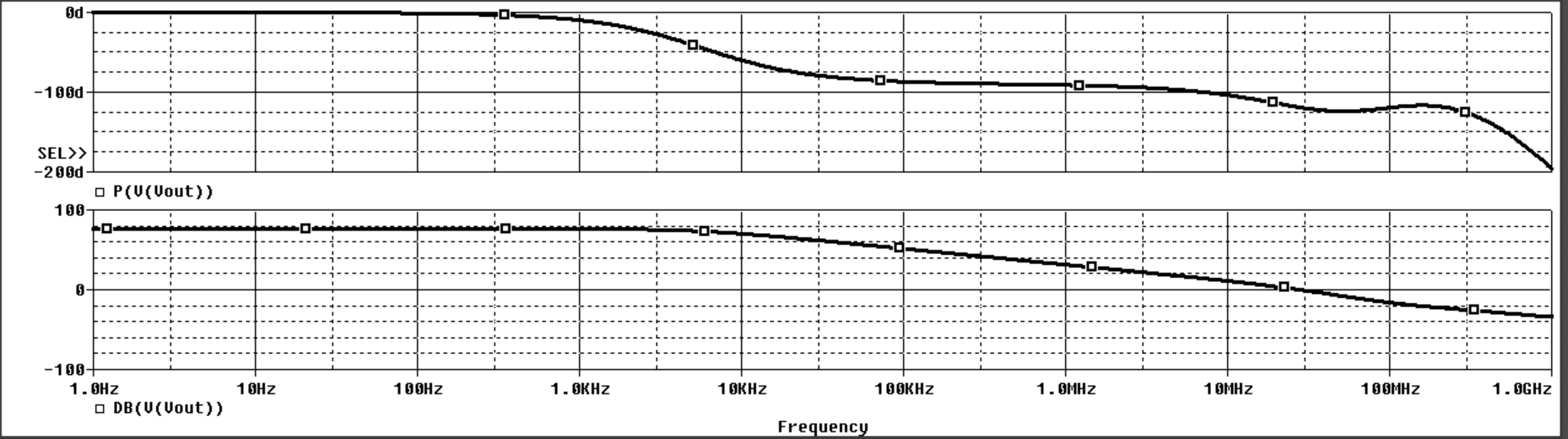
- Achieve DC differential gain above 70 dB
- Maintain phase margin above 60° at the unity-gain frequency
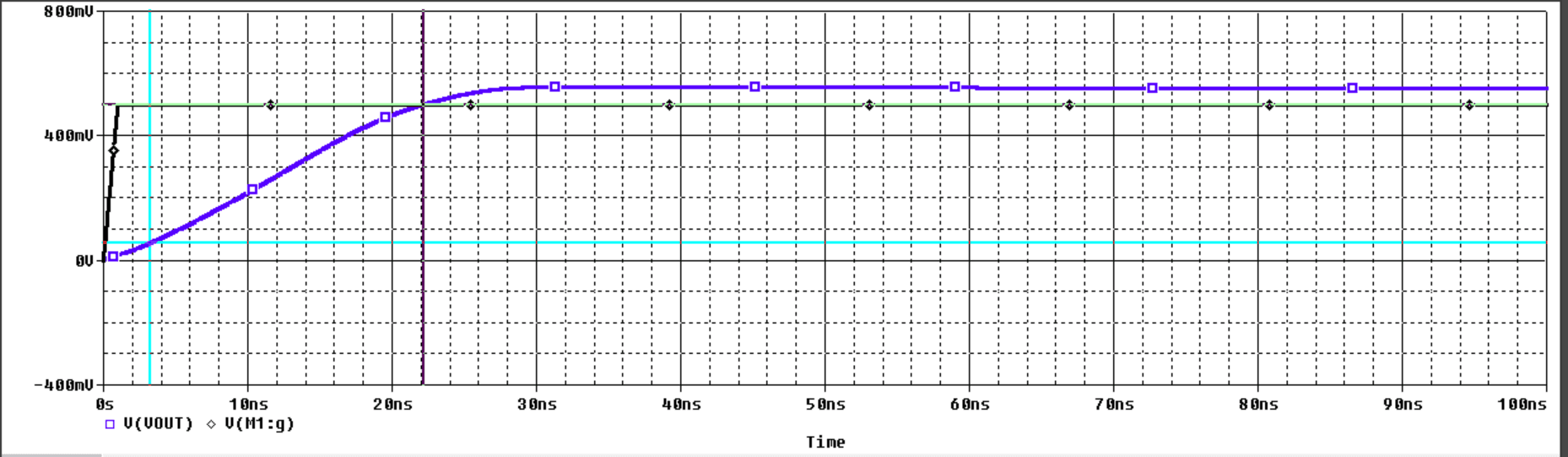
- Meet a slew rate target of 25.2 V/µs
- Maximize gain–bandwidth product while minimizing bias current
Outcomes & Contributions
- Sized all 16 MOSFETs (W and L) from the target slew rate and a gm/Id of ~20 V⁻¹ on the input pair
- Split gain evenly between the PMOS input stage and NMOS common-gate stage, with intrinsic gain ~2× each stage's share
- Built a PMOS cascode current mirror load (L = 2× the cascode devices) with VGS = 1 V for near-zero output offset
- Ran DC operating point, AC, CMRR, and transient simulations, iterating widths until specs closed
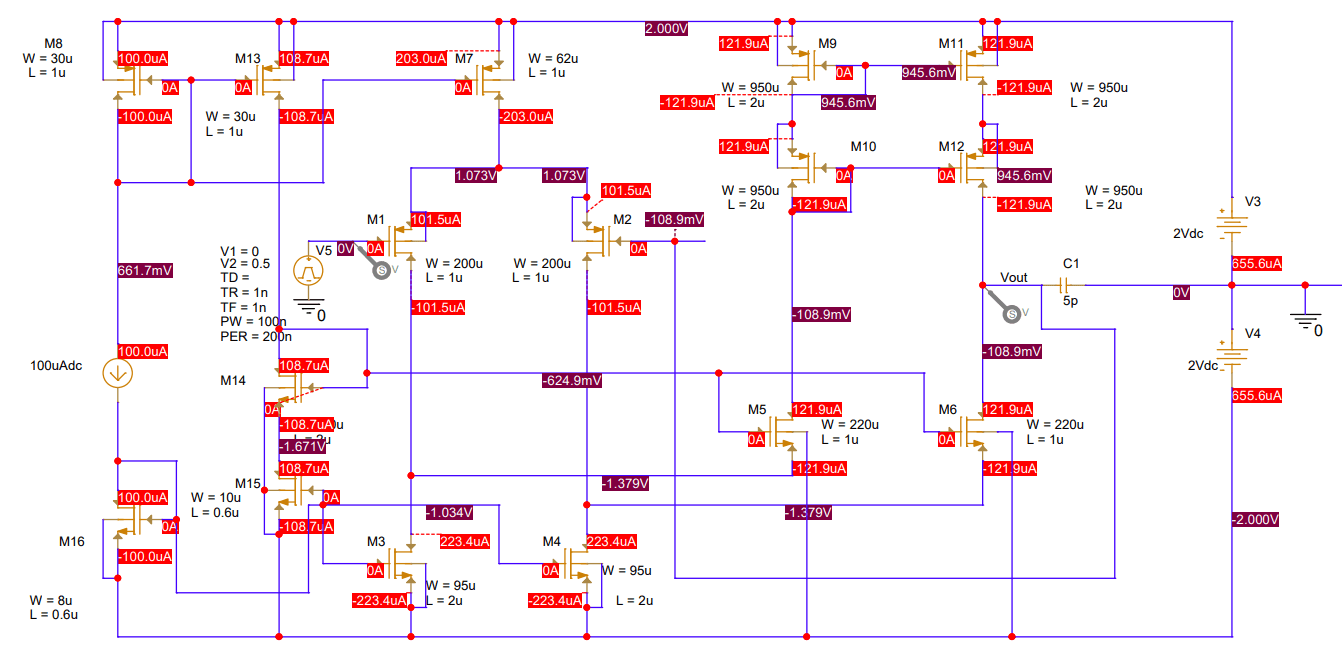
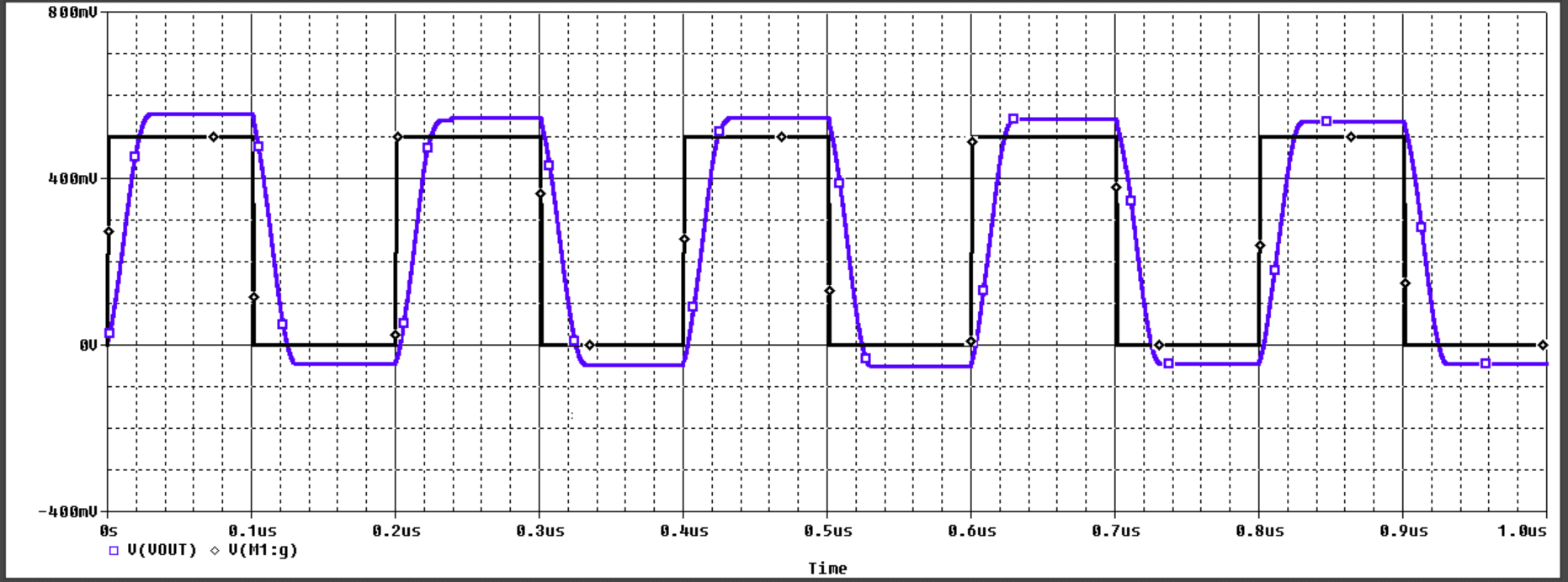
- Verified the amplifier as a unity-gain buffer with a 0.5 V pulse input
- Benchmarked against a two-stage op-amp from an earlier assignment: matched GBW (27.9 vs 27.8 MHz) and gained ~4.4 dB of DC gain with no compensation network, at 2.6× the supply current
Results
| Parameter | Target | Measured |
|---|---|---|
| DC Gain | > 70 dB | 76.21 dB |
| Unity-Gain Freq (GBW) | — | 27.9 MHz |
| Phase Margin | > 60° | 61.04° |
| Slew Rate | 25.2 V/µs | 23.48 V/µs |
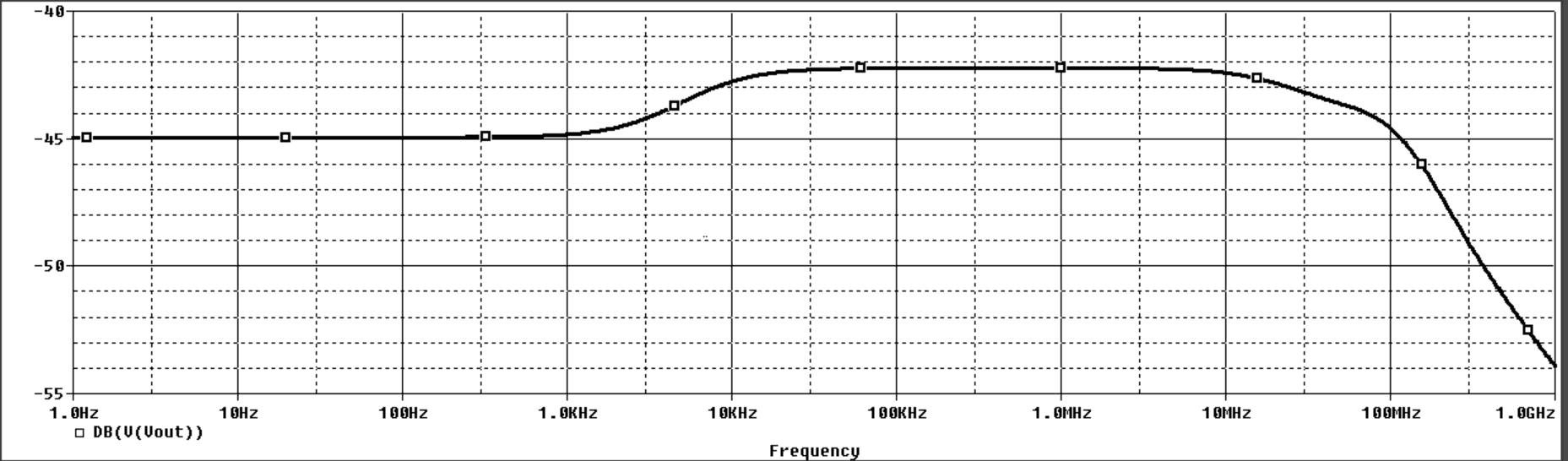
| CMRR Pole (−3 dB) | — | ≈ 125 MHz |
| Supply Current | — | 656 µA |
Slew rate landed about 7% under target; all other specs were met.
Technical Details & Skills
Topology
PMOS differential pair, NMOS common-gate fold, PMOS cascode current mirror, 5 pF load
Analysis
gm/Id Sizing, DC Bias, AC/Bode, CMRR, Transient, Slew Rate
Tools
Cadence PSpice
Open-Loop Schematic
Gain & Phase
CMRR
Unity-Gain Buffer
Transient Response
Slew Rate Measurement